Private Chat started from a very simple premise: not every conversation should become permanent software.
Most chat products optimize for continuity. Message history, user identity, search, retention, and long-lived accounts are treated as defaults. This project takes the opposite approach. A room should be quick to create, easy to share, useful for a short exchange, and then gone without ceremony.
That decision shapes the whole product. Private Chat is not trying to be a better Slack or a smaller Discord. It is a disposable room for real-time conversation, built around ephemerality rather than persistence.
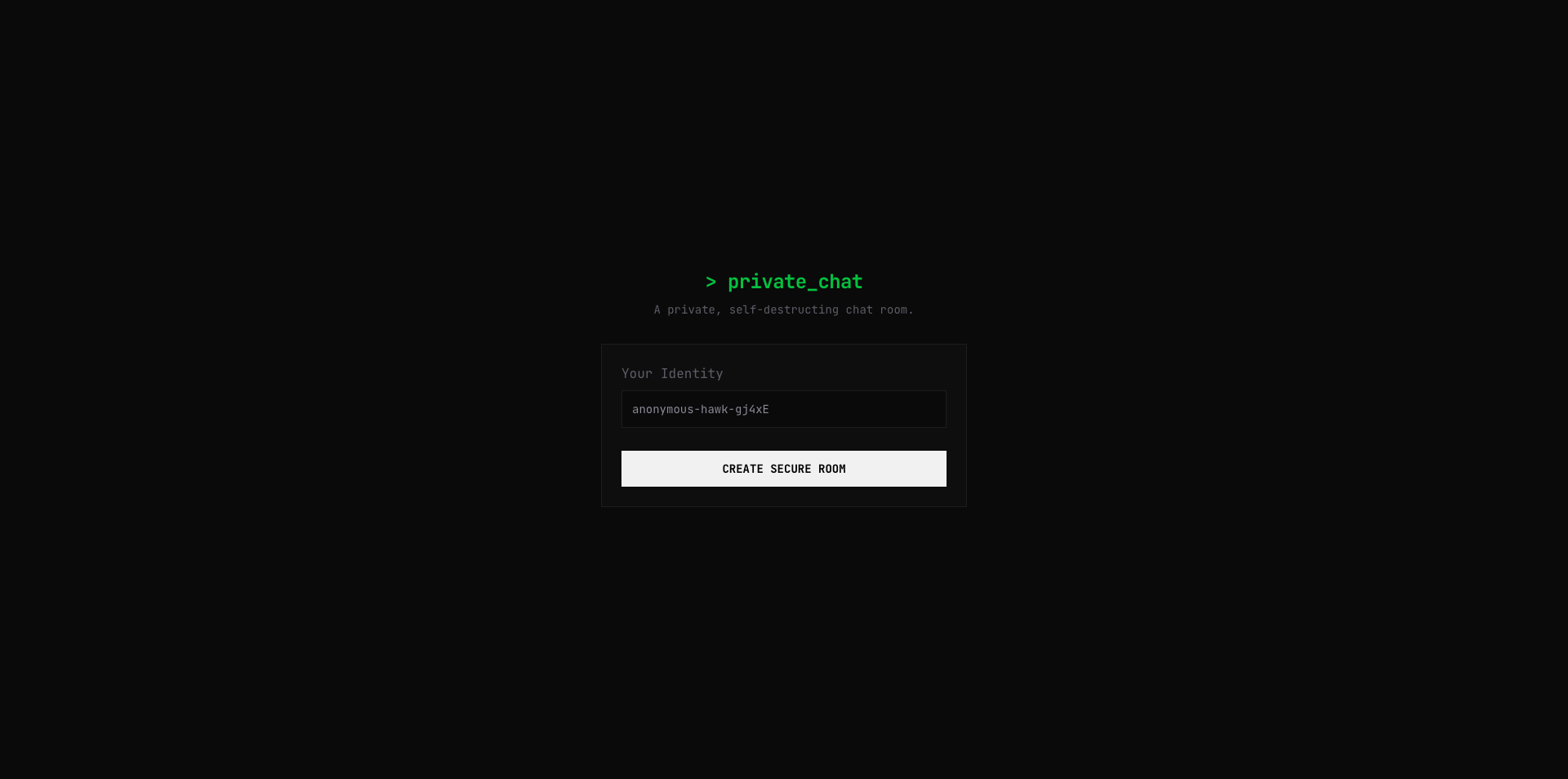
The Product
At its core, the flow is intentionally narrow:
- Create a room
- Share the generated link
- Chat in real time
- Let the room expire or destroy it manually
There are no accounts, no onboarding, and no attempt to turn the user into a long-term profile. The value comes from the lack of friction. You do not sign up, set a password, build a contact graph, or manage a workspace. You just open a temporary room and use it.
This makes the product feel closer to a secure disposable utility than a traditional messaging app.
Ephemeral by Default
The most important product decision is that the room itself has a lifespan.
Each room is created with a Redis-backed TTL of ten minutes. That timer is not decorative. It is the source of truth for the room’s existence. Messages live inside that temporary boundary, and once the room expires, the experience is over by design.
That changes the emotional tone of the app. It removes the expectation of archives, inboxes, and revisitability. The room exists for the moment it is needed, then disappears. This is what gives the project its privacy-first character without adding heavy cryptographic claims it does not need to make.

Anonymous Identity Without Account Friction
Private Chat still needs a basic sense of identity, but it handles that with restraint.
Instead of accounts, the app generates a lightweight anonymous username and stores it in local storage. That means the same browser keeps a stable identity across refreshes, but there is no user system to manage, secure, or expose.
This is one of the nicest balances in the project. Total anonymity can make a chat room feel chaotic. Full account systems make a temporary product feel heavy. A generated browser-level username sits neatly in the middle. It is enough to make the room legible without turning identity into the product.
Realtime Architecture
The frontend is built with Next.js App Router, while the backend is exposed through a single Elysia API surface. On the infrastructure side, the app leans on Upstash Redis for room and message storage and Upstash Realtime for low-friction live updates.
The shape of the system is straightforward:
- room metadata is stored in Redis with an expiration
- messages are written to Redis lists by room ID
- new messages are emitted as realtime events
- destruction events are also broadcast in realtime
That simplicity is a strength. The architecture matches the product instead of overshooting it. There is no unnecessary database layer, no permanent message model, and no heavy backend orchestration. The stack is serverless, event-driven, and narrow enough to stay understandable.
Destruction as a Real Feature
One of the more interesting parts of the app is that automatic expiration and manual destruction converge on the same idea: the room should have a clean end state.
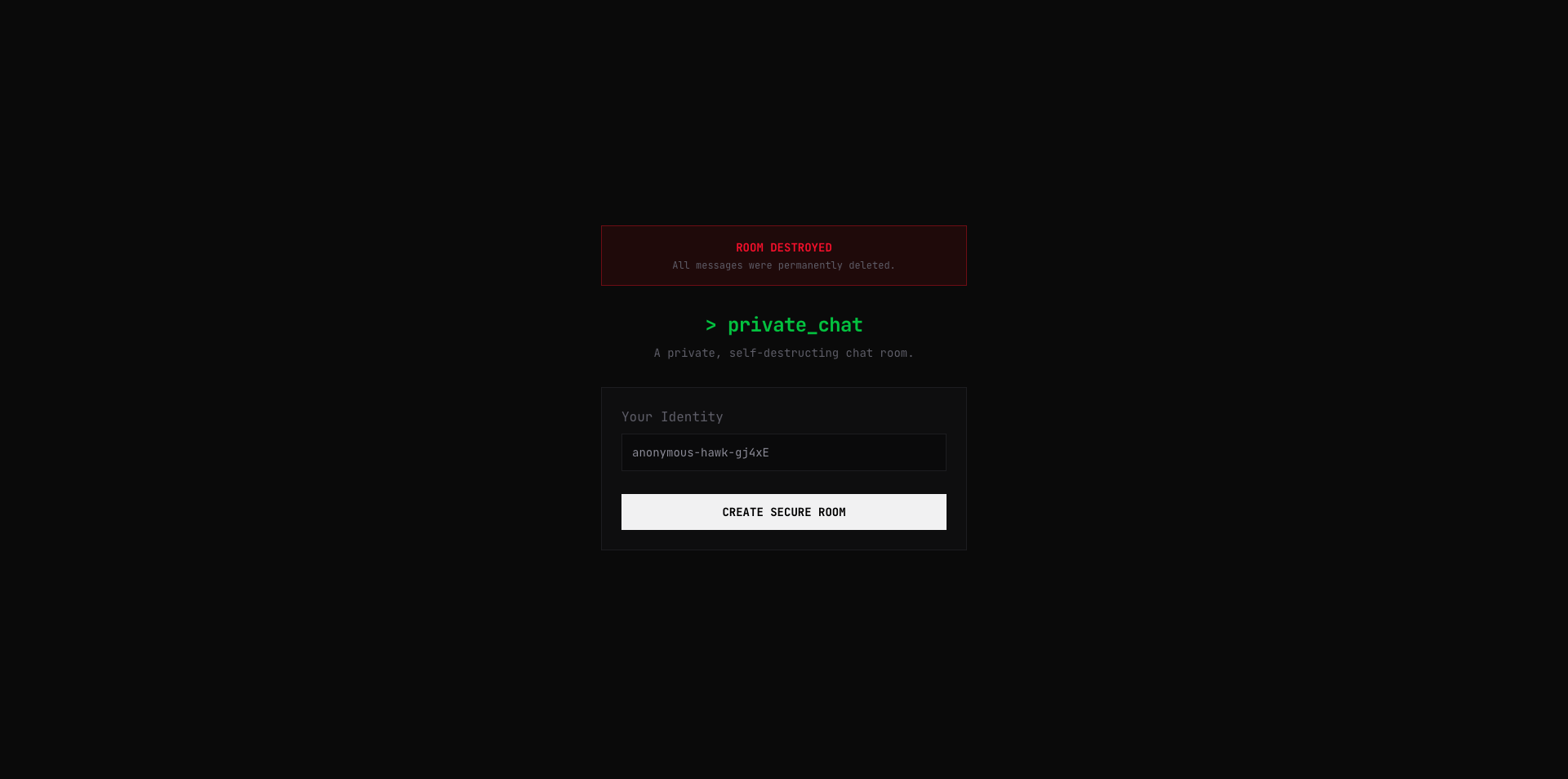
When a room is destroyed, the app clears the relevant Redis keys, emits a chat.destroy event, and pushes users back to the lobby with a clear status. The same is true when a room no longer exists. Instead of leaving users in a broken state, the product explains what happened:
- room destroyed
- room not found
- room full
This matters more than it sounds. Disposable products often handle failure carelessly because the room is “temporary anyway.” Here, the temporary nature of the room makes the ending even more important. The app has to tell the user exactly why the conversation is over.
Why It Feels Lightweight
The product stays convincing because it avoids feature creep.
There is no social layer. No friend system. No profile customization. No inbox. No message search. No retention settings. No “maybe we should keep just a little history.”
Instead, the app invests in a few things that actually support the core job:
- instant room creation
- stable anonymous usernames
- realtime message delivery
- a visible room timer
- explicit destruction
- clean redirects when a room ends
That restraint is what makes the project interesting. It proves that privacy-conscious software does not always need to become more complex. Sometimes it just needs to do less, more deliberately.
The Technical Stack
Every major piece in the stack serves the product well:
- Next.js for the UI and routing model
- Elysia for a lightweight API layer
- Upstash Redis for temporary room and message storage
- Upstash Realtime for message and room events
- TanStack Query for client-side fetching and cache updates
The project works because these choices reinforce the same goal: keep the product fast, disposable, and easy to reason about.
Closing Thoughts
Private Chat is a good example of how much product character can come from a single strong constraint.
By deciding that rooms should be temporary, the rest of the design becomes clearer. Identity becomes lighter. Storage becomes simpler. Realtime events become more important. Cleanup stops being an afterthought and becomes part of the product itself.
If I had to summarize it in one sentence, it would be this:
Private Chat is a self-destructing real-time chat app that uses Redis TTLs and live events to make temporary private rooms feel immediate, anonymous, and deliberate.
That is what makes it worth writing about. Not just that it is realtime, but that it is disciplined.